
Tracking (In)Justice Response to SOLGEN Regarding Proposed Change to Ontario Coroner’s Act to End Mandatory Inquests
Stakeholder Engagement on Proposed Legislative Change to End Mandatory Inquests for Non-Natural In Custody Deaths and Replace this Process with Annual Reviews for Deaths in Correctional Institutions in Ontario
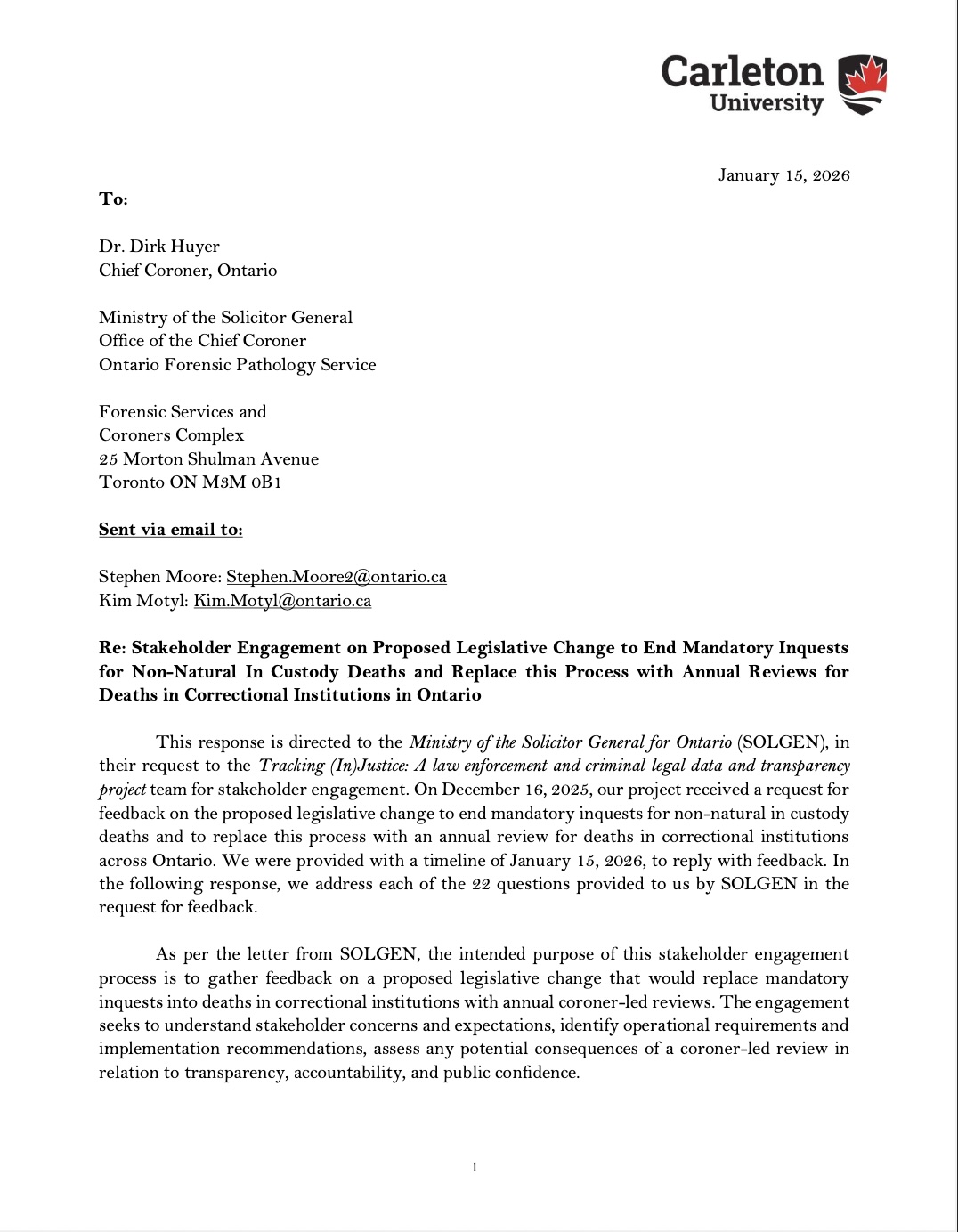
This response is directed to the Ministry of the Solicitor General for Ontario (SOLGEN), in their request to the Tracking (In)Justice: A law enforcement and criminal legal data and transparency project team for stakeholder engagement. On December 16, 2025, our project received a request for feedback on the proposed legislative change to end mandatory inquests for non-natural in custody deaths and to replace this process with an annual review for deaths in correctional institutions across Ontario. We were provided with a timeline of January 15, 2026, to reply with feedback. In the following response, we address each of the 22 questions provided to us by SOLGEN in the request for feedback. Download the complete letter here: SOLGEN Stakeholder Engagement Letter – Tracking Injustice January 15 2026
As we detail in our stakeholder response letter, our team has the following concerns, which are that the proposed legislative change:
Will further undermine transparency: Annual reviews have the potential to lack public and transparent hearings, with juries, the testing of evidence, and cross-examination. Internal SOLGEN-controlled reviews risk obscuring evidence, shielding institutional wrongdoing, and misrepresenting facts. Relying exclusively on annual reports to summarize deaths risks reducing individuals to footnotes and rendering deaths invisible to the public, erasing their humanity.
Will cause harm to families & loved ones: Ending inquests will mean that families and loved ones will be denied answers, opportunities for meaningful participation, and closure. Reduced access to inquests will retraumatize families and loved ones, and risks further undermining trust, as well as limiting the availability of information on deaths, and opportunities for answers. Inquests also provide a critical forum for families to share information about their loved ones. These insights are a valuable and often overlooked source of information in the investigative process.
Will result in inadequate investigations & risks of misrepresentation: Without detailed and thorough, case-by-case investigations, findings on the cause and manner of death may be inaccurate. Important systemic issues, including violence, neglect, non-compliance by correctional staff, and institutional failures, may be unaccounted for in the process. As a result, any recommendations arising from such inadequate investigations will lack the relevance and strength required to prevent future deaths.
Is presented in a context of persistent systemic failures to implement recommendations & the absence of effective accountability mechanisms: Systemic issues identified in past inquests continue, due to lack of political will, enforceable follow-through, and eliminated oversight and accountability structures. Chronic underfunding, inquest backlogs, and opposition to evidence disclosures reduce the effectiveness of existing mechanisms. Without independent advisory input or evaluation mechanisms, reviews risk being even more ineffective in realizing accountability than the current system.
Is presented within an inadequate framework of “public safety”: A narrow “public safety” lens adopted by SOLGEN excludes incarcerated people from accessing justice and protection. It also obscures the structural contributors to preventable deaths, such as the denial of healthcare and mental health supports, the ongoing deadly conditions of confinement, and the use of force.
Is not in compliance with Canada’s international human rights obligations: Ending mandatory inquests conflicts with international human rights standards, including Canada’s United Nations obligations to ensure independent and transparent investigations into deaths in custody.
The public can participate in providing feedback until January 19 via this online portal: https://www.regulatoryregistry.gov.on.ca/proposal/52933
Download the complete letter here: SOLGEN Stakeholder Engagement Letter – Tracking Injustice January 15 2026