
Prisoners’ Justice Day 2026

Since January, 2026, we have tracked 71 deaths in custody across Canada, including within both institutions in federal and provincial jurisdictions.
Download a list here of the 71 people who have died in custody so far this year (from January to July 2026). You can also view all of the names on our Memorial Page, or you can download your own list on our website’s Explore the Data page to create your own analysis.
In the last 8 months, we have tracked a minimum of 46 deaths in federal custody. While at the federal level, Corrections Service Canada, is mandated to disclose all deaths that occur within their custody, access to information at the provincial level is more inconsistent. We have collected some provincial custody data, however, there are challenges around accessing information on recent deaths. We do know that in Ontario there have been at least 14 deaths in provincial custody, 3 in Nova Scotia, 3 in Manitoba, and 1 death in the North West Territories. These provincial numbers do not reflect the total number as there may be other deaths that are still under investigation, and therefore not disclosed to the public. We have documented 25 provincial deaths, but we believe this could be higher.
The database now includes 2,411 deaths in custody across Canada since the year 2000. Due to limited access to information, this is a bare minimum of the total number of deaths in custody over the past 26 years. As this is a living database, our team is updating the data on an ongoing basis when more information about deaths becomes available.
The average age of death for those in the database is 45.2 years old. The average age of death in the database for cismen is 44.9 years and for ciswomen is 37.3 years. By comparison, according to Statistics Canada, life expectancy as of 2024 in Canada was 81 years old.
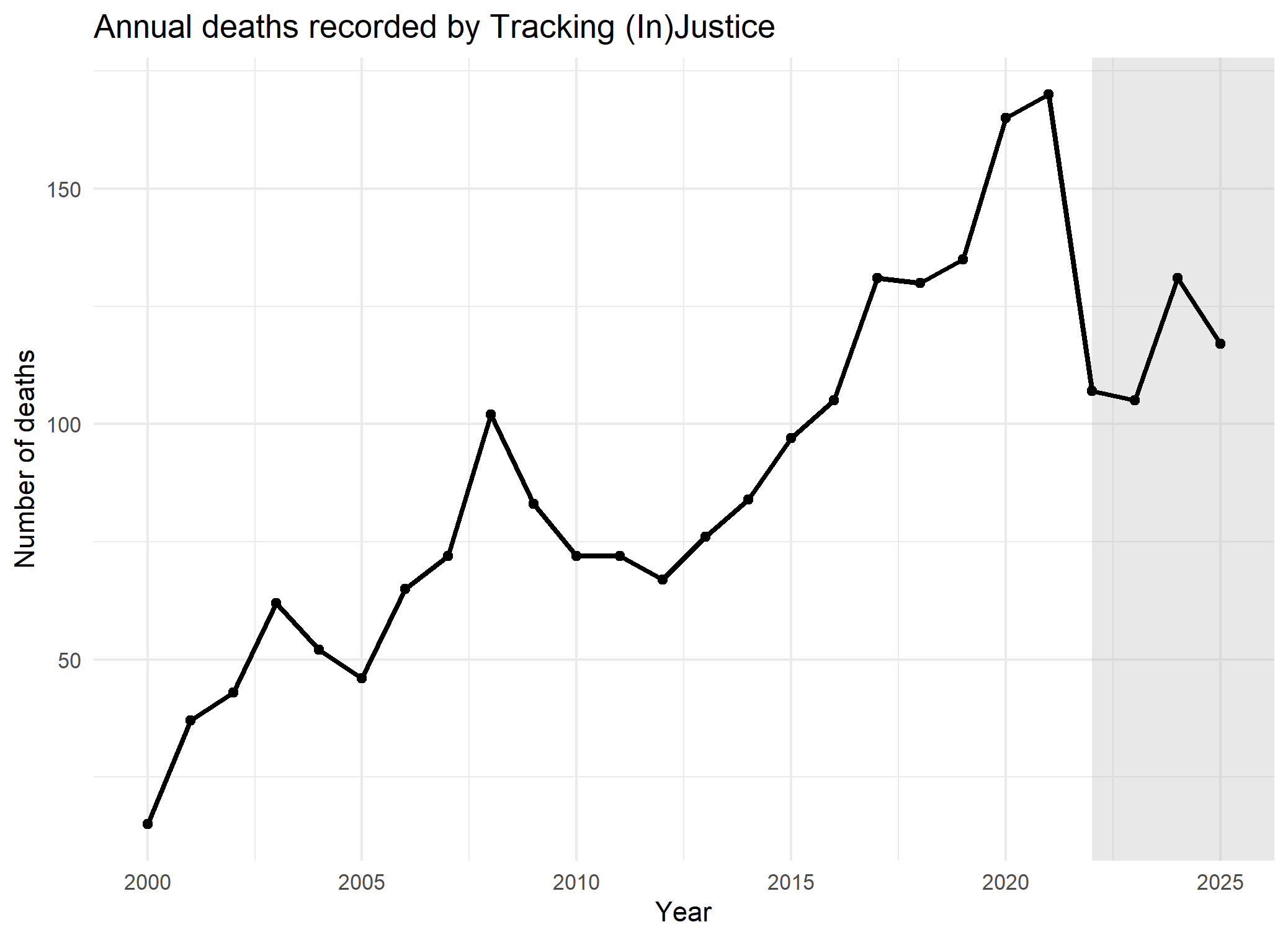
This chart indicates the number of deaths we have tracked each year. Over the 26 years of data collected, there is an average of 87 deaths per year in the database. However, from 2015 to 2022, the average number of deaths in the database is over 118 per year. After 2022, our data is less accurate. The grey bar indicates the time frame where we have limited access to accurate data, due to ongoing investigations and institutional delays.
Ontario government proposes to end mandatory inquests for all deaths in custody
In December 2025, the Ontario government quietly proposed amendments to the Coroners Act that would eliminate mandatory public inquests into non-natural deaths in provincial and federal correctional institutions and replace them with a coroner-led annual review process.
While framed as a way to improve efficiency and reduce trauma for families, the proposed change raises serious concerns about transparency, accountability, and the ability of families and the public to understand how and why people die in custody.
Public inquests allow evidence to be examined, witnesses and experts to testify, and juries to make the final verdict for manner of death, and to make recommendations intended to prevent future deaths, and can also reveal systemic failures that might otherwise remain hidden. Families awaiting inquests have told us they were not consulted about the proposed changes and fear they may never learn the full circumstances surrounding their loved ones’ deaths.
Although families could request a discretionary inquest under the proposed model, there is no guarantee one would be granted, placing an additional burden on grieving families navigating complex legal and government systems. For people without family or advocates, the consequences are even greater: without a mandatory public process, there may be no one left to speak for them.
Tracking (In)Justice submitted a response to the Chief Coroner of Ontario outlining these concerns, including what will happen to families currently awaiting inquests and how recommendations arising from annual reviews would be implemented when thousands of recommendations from previous inquests remain outstanding.
Take Action: Sign this open letter to oppose changing the Ontario coroners act! SIGN HERE!
Recognition of human rights violations regarding deaths in custody by the UN
In February 2026, Tracking (In)Justice submitted a report to the United Nations Human Rights Committee ahead of its review of Canada’s compliance with the International Covenant on Civil and Political Rights (ICCPR). The submission raises concerns about Canada’s ongoing human rights obligations within policing and correctional systems, with particular attention to deaths in custody, deaths resulting from police use of force, inadequate civilian oversight, limited mechanisms for investigating these deaths, and racial inequities within the criminal legal system.
The UN Human Rights Committee received over 40 submissions, and they responded to a number of specific recommendations that Canada should address to be compliant with the international human rights standards, including implementing the United Nations Standard Minimum Rules for the Treatment of Prisoners (the Nelson Mandela Rules) and the Minnesota Protocol on the Investigation of Potentially Unlawful Deaths. The outcome report is here.
What is Prisoners’ Justice Day?
First observed in 1975, Prisoners’ Justice Day is an annual day of resistance and memorial to commemorate the death of Eddie Nalon, who was left to die alone in the segregation unit on August 10th, 1974. In 1976, Robert Landers also died alone in solitary confinement. In response, prisoners at Millhaven organized a one-day hunger and work strikes in opposition to the use of solitary confinement, in support of prisoners’ rights, and in memory of Eddie Nalon and Robert Landers.
What is Tracking (In)Justice?
Tracking (In)Justice is a law enforcement and criminal legal data and transparency project that tracks and analyzes police-involved deaths and deaths in custody across Canada. We believe that accurate and verifiable data is one way to support communities advocating for justice, accountability, and transparency from state officials and oversight bodies. Learn more about us here.
How can people use the database?
People can search the database using the variables on our website to create their own analysis. For example, to get a snapshot of how many people have died in each institution, you can search the deaths by institution in which they occurred. Or, to understand patterns over time, you can search by date and manner of death, or other factors such as gender or type of custody. Custom searches are available for download via the Excel or CSV file button function on the Explore the Data page.
To learn more about our methods and to explore the data, look here.
Until more analysis can be conducted, we urge caution in interpreting the database findings as a real world understanding of deaths in custody across Canada. But as this is the largest dataset on deaths in custody ever created in Canada, and our data sources are mostly directly from government sources, we believe the data can give us a strong indication of potential trends which warrant further investigation.