
Tracking Police Oversight: A Review of Canadian Law Enforcement Oversight Agency Outcomes (2020–2025)


This report examines how police oversight works across Canada and whether it delivers accountability when people die during police use of force. Drawing on original research from the Tracking (In)Justice project, it combines national data (2020–2025) with interviews with eight family members who lost a loved one due to police violence.
The report links outcomes across Canada’s eight oversight agencies to 333 police use-of-force deaths recorded between 2020 and 2025 and combines those findings with interviews conducted with family members who participated in oversight processes.
Key findings:
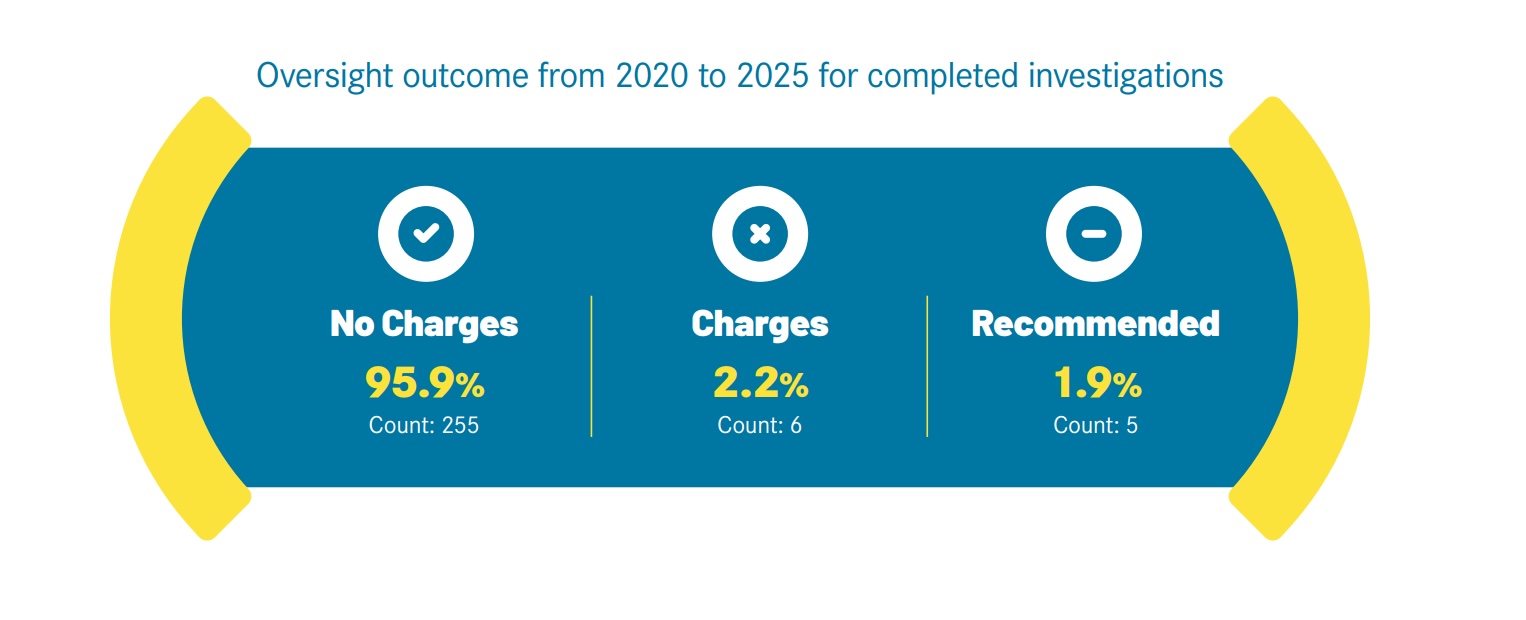
In a context where police-involved deaths are increasing, accountability through civilian oversight is extremely rare. Of 266 investigated cases with known outcomes between 2020–2025, 95.9% resulted in no charges against police. Only 4.2% led to charges or recommendations, a majority of which were later dropped.
 Oversight systems lack transparency and consistency. Public reporting varies widely across provinces, with limited access to detailed case information, making it difficult to evaluate effectiveness or build public trust.
Racial disparities persist. Indigenous and Black people are overrepresented in deaths involving police use of force relative to their share of the population. This is a specific concern regarding the overuse of police firearms, where Indigenous and Black together comprise 10.4% of the population in Canada, they represent 27.4% percent of all shooting deaths identified.
Many victims are unarmed. At least 30% of those killed between 2020 and 2025 were understood to be unarmed, raising further concerns about proportionality in the use of force.
Investigations face structural barriers. The criminal law scope of oversight agencies severely limits possibilities for accountability. Furthermore, police officers under investigation can legally refuse to be interviewed, which limits the ability to fully examine incidents.
Families of people killed during police use of force incidents report serious problems with investigations. Interviews with eight family members from across Canada highlight recurring issues. These experiences contribute to deep mistrust in oversight processes, which include:
- Lack of independence and bias
- Reliance on police narratives
- Missing or destroyed evidence
- Incomplete investigations
- Poor communication and limited access to assess evidence
- Lack of grief and trauma-informed care
While civilian oversight agencies were created to ensure accountability and public trust, this research finds they rarely produce meaningful consequences for police wrongdoing. Structural limits, lack of transparency, and investigative weaknesses undermine their effectiveness, especially in a context of rising deaths and ongoing racial inequities.
Download the data we used to develop the quantitative analysis: Tracking-Injustice-Oversight-Outcomes-Report-Data